
Essential Human Movements & Abilities
Barefooting, Heel Raising & Foot Training – So you can develop the strength, stability, mobility, alignment, control, resilience, and sensory awareness needed to support your body weight, absorb force, maintain balance, clear your toes, improve circulation, and truly connect with the ground. Your feet are your foundation. Retraining and strengthening them should be a priority.
Freestyle Variable Movement & Dancing – So you can give yourself permission to move freely, strengthen your mind-to-body connection, and develop greater trust, confidence, and safety within your body. Moving through different rhythms, directions, positions, speeds, and levels develops balance, locomotion, rotation, coordination, reactive core strength, and the ability to produce and absorb force. It stimulates your muscles, tendons, and ligaments and supports fluid exchange within the fascia. Practicing barefoot increases sensory feedback, strengthens your feet and ankles, and improves your connection with the ground. Dancing combines nearly every foundational human movement through creativity, expression, and play. If everyone danced, the world would be a healthier and happier place!
Walking – So you can maintain an efficient gait and proper hip extension, continue living independently, and support cardiovascular and metabolic health, joint mobility, circulation, balance, mental and cognitive health, and longevity.
Floor Sitting, Kneeling, Crawling, Rolling & Ground Transitions – So you can sit and kneel on the floor in different positions, crawl on your hands and knees, roll and reposition your body, transition comfortably between ground-level positions, safely lower yourself to the floor, and get back up without assistance while maintaining mobility, coordination, stability, shoulder function, and core integration.
Leg Raising & Balancing – So you can stabilize and balance on one leg while raising and lifting the other leg in different directions. This allows you to step over objects forward and laterally, get into vehicles and bathtubs, dress independently, clear obstacles, change positions, and move freely with greater stability and control.
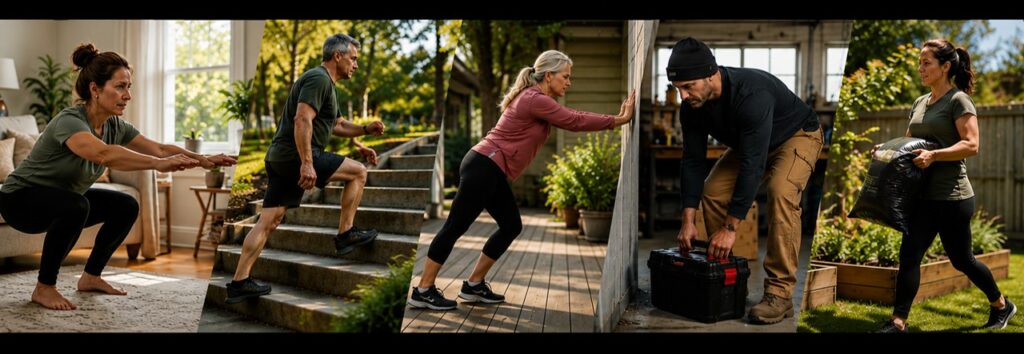
Stepping Up & Down, Ascending, Descending & Climbing – So you can safely navigate curbs, actual flights of stairs, hills, ramps, ladders, uneven terrain, higher surfaces, and vehicles with the strength, balance, coordination, endurance, and control needed to support your knees, absorb force, and reduce the risk of falls and injuries. Regularly using stairs helps preserve this essential ability.
Spinal Mobility, Rotation & Rib Cage Expansion – So you can safely flex, extend, side bend, and rotate through your neck, upper, mid, and lower back while allowing your rib cage to move, expand, and contract in multiple directions. This supports effective breathing, posture, core function, nervous system regulation, and the mobility needed to bend, reach, turn, change positions, and move freely throughout everyday life.
Anti-Rotation / Bracing – So you can support and control your own body weight, stabilize your body, and resist unwanted movement while lifting, carrying, pushing, pulling, walking, and responding to unexpected forces.
Bilateral & Unilateral Squatting – So you can sit down and stand up independently, continue to use the toilet unassisted, safely lower yourself toward the ground, and maintain lower-body strength and mobility as you age.
Bilateral & Unilateral Hinging / Bending – So you can safely bend forward, reach toward the floor, and return to standing without losing your balance while properly loading and using your posterior chain muscles, including your glutes, hamstrings, and spinal erectors, with support from your core.
Multi-Directional Lunging – So you can safely lower yourself through split positions, reach toward the ground, move forward, backward, sideways, and diagonally, recover your balance after a stumble, and build stability and strength on both sides of your body.
Lifting & Lowering – So you can safely pick up, lift, lower, and set down children, pets, groceries, and household items using an appropriate combination of squatting, hinging, lunging, reaching, gripping, bracing, and balance.
Arm Raising & Reaching – So you can safely reach overhead, forward, sideways, across, and behind your body, access and lift objects, maintain shoulder mobility, and move your arms freely without unnecessary strain on your shoulders, neck, or back.
Pushing – So you can safely push away from your body in multiple directions, push doors, shopping carts, strollers, lawn and snow equipment, furniture, and other objects, push yourself away from the floor or out of a bathtub or pool, and maintain the strength, stability, coordination, and control needed for independence.
Pulling – So you can safely pull or row toward your body from multiple directions, pull doors and objects toward you, drag or reposition objects, use railings, and maintain the strength, stability, grip, and control needed for independence.
Gripping, Holding & Manipulating Objects – So you can securely grip and hold objects of different shapes, sizes, and weights, use handles and railings, open containers, turn knobs, use tools, and maintain the hand, wrist, and forearm strength needed for everyday life.
Carrying – So you can safely carry groceries, cookware, household items, laundry, luggage, children, pets, and other objects beside your body, in front of you, against your body, or unevenly on one side while maintaining grip, balance, posture, core stability, and control.
Catching & Throwing – So you can safely catch, control, and throw with one or both hands while improving visual tracking, coordination, reaction time, balance, grip, joint stability, stepping, rotation, bracing, and force production.
Running, Pivoting & Moving Quickly in Multiple Directions – So you can accelerate, slow down, stop, pivot, change direction, and shuffle laterally when necessary, including during emergency situations, while developing cardiovascular fitness, coordination, agility, work capacity, speed, power, resilience, and overall physical capability.
Jumping, Landing, Hopping, Leaping & Skipping – So you can maintain bone-loading capacity, lower-body power, elasticity, tendon health, single-leg stability, coordination, agility, reactive ability, landing control, and the ability to safely produce and absorb force.
Assisted, Passive & Active Hanging – So you can develop the grip, forearm, shoulder, upper-body, and core strength and control needed to support some or all of your body weight from an overhead position. Hanging can help maintain overhead shoulder mobility, provide temporary spinal unloading, improve shoulder stability, and develop the strength needed for pulling and climbing.