My Training Philosophy

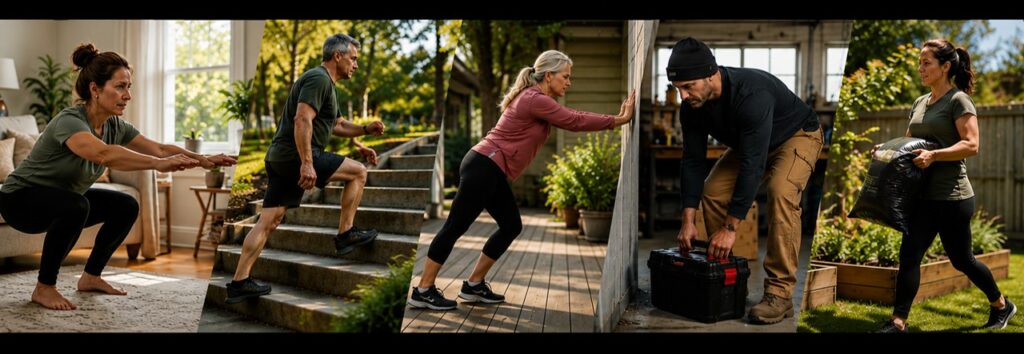
I believe exercise and training should prepare you for REAL life.

My training programs focus on helping you build and maintain the essential movements and physical abilities that support health, independence, resilience, longevity, and injury prevention throughout every stage of life.

Human health depends on regular movement, awareness, proper alignment, movement variability, load, coordination, balance, breathing, exploration, play, and interaction with YOUR environment.

Unfortunately, modern lifestyles built around comfort, convenience, technology, sedentary living, repetitive movement patterns, restrictive footwear, and disconnection from nature have caused many people to lose essential movement abilities.

If you don’t USE it, you LOSE it.

When we stop regularly performing foundational human movements in everyday life, that’s when we need to intentionally train them.

This is something we need to take more seriously as our health and medical care systems become increasingly overburdened. Reclaiming your physical health starts with reclaiming your autonomy, awareness, and connection to your body.

That’s why I focus on helping clients rebuild strength, mobility, stability, coordination, balance, endurance, and real-world physical capability using appropriate progressions that meet people where they are.

I teach people how to move better within their real-life environments at home, at work, outdoors, while traveling, and everywhere in between using both minimal and traditional equipment when available.

While health, strength, and function are always the foundation, I understand that looking good and feeling confident are important parts of health, healing, happiness, and overall quality of life. As movement quality and physical capacity improve, I also help clients tone and sculpt their bodies in a realistic and sustainable way.

Below are the foundational movements and physical abilities I believe every human should be able to perform and maintain throughout life.

These movements are essential for everyday function, independence, adaptability, resilience, injury prevention, and long-term quality of life. Many of them were once naturally built into human life, but modern living has dramatically reduced how often we perform them.

My goal is to help clients safely rebuild, strengthen, maintain, and progress these essential movement abilities so they can continue to fully live life for as long as possible.

This is how we live strong and die young… as late as possible. 🔥💪

Please note: Movements are recommended and added to programming if and when it’s absolutely safe to do so.

Essential Lower Body Movements & Abilities

Barefooting – So your feet can build the necessary muscle, strength, stability, mobility, alignment, and sensory awareness needed to function, absorb force, balance, and connect with the ground the way they were designed to.

Heel Raising – So you can safely reach overhead, climb stairs, walk hills, improve balance, support healthy circulation and blood flow through strong active calves, and reduce the risk of ankle, foot, and Achilles injuries.

Squatting – So you can sit down and stand up independently, continue to use the toilet unassisted, safely get lower to the ground, and maintain lower body strength and mobility as you age.

Hinging / Bending – So you can safely pick things up from the floor without falling over, protect your back, and learn to properly use the muscles of your hips, glutes, hamstrings, and core.

Leg Lifting & Swinging – So you can stabilize on one leg while stepping over objects, getting into vehicles, climbing into bathtubs, dressing independently, and moving freely without restriction.

Lunging – So you can safely lower yourself, recover balance, move through split positions, improve stability between both sides of the body, and improve muscular imbalances.

Stepping Up – So you can safely step onto curbs, stairs, uneven terrain, higher surfaces, and larger vehicles with strength, balance, and control.

Stepping Down – So you can safely descend stairs, curbs, uneven terrain, and larger vehicles while properly controlling your body weight, absorbing force, and reducing the risk of falls and knee injuries.

Essential Upper Body Movements & Abilities

Breathing / Rib Cage Expansion – So you can improve rib cage mobility, posture, nervous system regulation, core function, movement efficiency, oxygen delivery, and overall physical performance while reducing unnecessary tension throughout the body.

Pushing / Pressing – So you can push doors, push yourself up from the floor, out of a bathtub or pool, move objects safely, and maintain upper body strength and independence.

Pulling / Rowing – So you can safely pull objects toward you, improve posture, support shoulder health, and maintain upper body strength, stability, and control.

Arm Raising & Swinging – So you can safely reach overhead and behind you, lift objects, maintain shoulder mobility, and move your arms freely without straining your shoulders, neck, or back.

Holding / Gripping – So you can hold heavy objects, open jars, maintain hand and forearm strength, and preserve independence in everyday tasks.

Essential Full Body Movements & Abilities

Sitting – So you can learn how to sit well with proper posture, comfortably transition in and out of seated positions, maintain hip, spine, and lower body mobility, breathe properly, and improve core strength and stability.

Walking – So you can walk in multiple directions, continue living independently, and maintain cardiovascular health, metabolic health, joint health, circulation, mobility, mental health, and longevity.

Balancing – So you can improve stability, coordination, body awareness, reaction ability, fall prevention, and confidently navigate real-life environments and changing terrain.

Getting Down to the Ground – So you can safely lower yourself to the floor with control, mobility, and body awareness.

Getting Up from the Ground – So you can maintain functional independence, strength, coordination, and longevity without needing assistance to get back up.

Lifting from the Ground – So you can safely pick up children, groceries, household items, and everyday objects without unnecessary strain or injury.

Carrying – So you can continue carrying groceries, household items, children, and other objects safely while improving grip strength, posture, core stability, and overall functional strength.

Rotating – So you can improve rib cage mobility, breathe properly, and move efficiently through everyday twisting and turning motions while supporting spinal and joint health.

Anti-Rotation / Bracing – So you can build core strength while stabilizing and protecting your spine during movement, lifting, carrying, and daily activities.

Throwing – So you can safely throw objects with one or both arms without unnecessarily stressing your shoulders, tendons, ligaments, or spine.

Catching – So you can safely catch and control objects with one or both arms while improving coordination, reaction ability, and joint stability.

Crawling – So you can move effectively in emergency situations while improving coordination, mobility, stability, posture, shoulder function, and core integration.

Climbing / Ascending – So you can safely navigate stairs, hills, ramps, ladders, playgrounds, and uneven environments with strength, balance, and control.

Descending – So you can safely walk down stairs, hills, ramps, and changing terrain while maintaining balance, coordination, force control, and lower body stability.

Hopping, Leaping & Skipping – To improve stability, coordination, elasticity, tendon health, agility, balance, force absorption, and power production.

Jumping – To maintain lower body power, reaction ability, bone health, athleticism, coordination, and force absorption capacity.

Pivoting – So you can safely change direction, rotate efficiently, and reduce injury risk during movement and everyday activities.

Running – So you can move quickly in emergency situations while improving cardiovascular fitness, VO2 max, work capacity, athleticism, resilience, and overall physical capability.

Joint Health, Mobility, Stability & Strength

I also focus heavily on improving the mobility, stability, strength, control, and function of the following major joint complexes:

  • Neck
  • Shoulders
  • Elbows
  • Hands & Wrists
  • Hips
  • Knees
  • Feet & Ankles

While many programs isolate muscles, my approach focuses heavily on integrated movement and teaching the body to function as a connected system.

Because real life doesn’t happen one muscle at a time. 💪